
Penicillium globosum L., Cai, Houbraken & X.Z. Jiang in Diao, Chen, Jiang, Houbraken, Barbosa, Cai & Wu, Cladistics: 10.1111/cla.12365, 16 (2018).
MycoBank number: MB 818149; Index Fungorum number: IF 818149; Faceoffungi number: FoF 11432;
No synonyms
Description
Culture characteristics: Colonies growing after 5 days at 25 ± 2 ºC on following agar media: CYA colonies medium growing, sulcate, slightly umbonate towards centre, filiform mycelia, cottony, mycelium greyish green (26E4), 13–14 mm in diam.; margins irregular, deep; sporulation greyish green (27E5) to white (26A1); exudate absent; soluble pigment absent; reverse filamentous, mycelia deep green (29E8) with the outline of white, sporulation greyish green (25D4) to cream (4A3). MEA colonies medium growing, velutinous, flat, powdery, dull green (26D3) mycelia, 12–13 mm in diam.; margins regular; sporulation greyish green to ocean green with the white periphery, often raised centrally; exudates absent; soluble pigments absent; reverse mycelia oyster grey (2C2), yellowish-white (1A2), yellowish-grey (3B2), pistachio green (28C4), greyish-green (29B3), sporulation white (29A1). CYAS colonies slow-growing, floccose, cottony, umbonate, mycelia greyish green (26B1),10 mm in diam.; margin irregular; sporulation greyish green (26C3) and white; exudates absent; soluble pigments absent; reverse wrinkled, white (6D4) mycelia, brownish beige in between periphery and mycelia, sporulation white (6A1). OA colonies fast-growing, slightly suppressed, powdery, mycelia greyish green (26E5), 20 mm in diam.; margin regular; sporulation white (26A1) to greenish-white (26A2); exudates absent; soluble pigments absent; reverse mycelia white, sporulation greenish-white (27A2). CZ colonies slow-growing, powdery, flat, cream (4A3), 3-5 mm in diam.; margin irregular; exudates absent; soluble pigments absent; reverse yellowish-white (4A2) mycelia, sporulation cream (4A3). DG18 colonies slow-growing, flat, cottony, mycelium silver white (2B2), 8–9 mm diam.; margin irregular; sporulation whit; exudates absent; soluble pigments absent; reverse mycelia silver white (2B3), sporulation white. YES colonies fast-growing, sulcate, cottony, umbonate towards mycelia, filiform mycelia, mycelia greyish green, 24–25 mm diam.; margin irregular; sporulation white; exudates absent; soluble pigments absent; reverse filamentous, mycelia jade green (27E5), sporulation white. CREA colonies flat, cottony, orange white (5A2) mycelia, 8–9 mm in diam.; margin irregular; sporulation white; reverse pastel yellow (3A4), mycelia greyish orange (5D6), white sporulation; acid production present. Conidiophores predominantly biverticillate, rarely monoverticillate; stipes rough walled, 40–150 × 3.2–4µm; metulae 2–4 per stipe, predominantly divergent, 7.5–20.5 × 2.5–4 µm; phialides ampulliform, 2–19 per metulae, 7.5–13 × 2.5–4 μm; conidia smooth, globose to subglobose, 3.4–4.1 × 2.5–3.8 μm; sclerotia not observed.
Material examined: INDIA, Tamil Nadu, Madurai (09°55′35″ N 78°07′23″ E), from soil sample, 06 August 2019, Rajeshkumar K.C. and Sanjay Raveendran (NFCCI 5061).
Distribution: China and Korea
Sequence data from this collection: ITS: OK342120 (ITS5/ITS4); BenA: OL652653 (Bt2a/Bt2b); CaM: OM948800 (CMD5/CMD6); RPB2: OL652657 (fRPB2-5F/fRPB2-7cR)
Notes: Based on a concatenated phylogenetic analyses of the ITS, BenA, CaM, and RPB2 gene regions, the isolated strain of P. globosum (NFCCI 5061) aligns with the type stain of P. globosum (CBS144639). Morphologically, both strains share the same characters such as biverticillate conidiophores with globose to sub-globose conidia having smooth ornamentation. However, Penicillium globosum has not been reported from India and this is the first report.
Importance of species to humans or ecosystem: There is no record of any threat to humans or ecosystem, Quarantine significance: No data available regarding quarantine. Fungi belonging to BS level I
Biochemical importance of species, chemical diversity or application: No data available
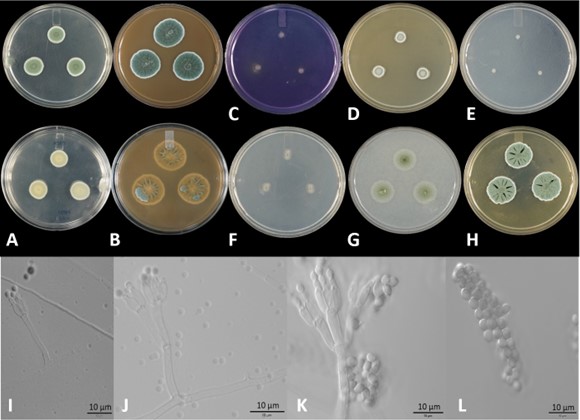
Fig. 1. Penicillium globosum. A, B Colonies after 5d at 25± 2 ºC on CYA and MEA obverse and reverse. C CREA obverse. D CYAS obverse. E CZA obverse. F DG18 obverse. G OA (natural) obverse. H YES obverse. I monoverticillate conidiophore. J-K Biverticillate penicillin. L Conidia. Scale bar: I-L=10 μm.