
Trichothecium Link, Mag. Gesell. naturf. Freunde, Berlin 3(1-2): 18 (1809)
MycoBank number: MB 10303; Index Fungorum number: IF 10303; Facesoffungi number: FoF 13427; 27 morphological species (Species Fungorum 2020), 5 species with sequence data.
Type species – Trichothecium roseum (Pers.) Link
Notes – Trichothecium was erected by Link (1809) to accommodate T. roseum as the type species and was reported on dried pods of Delonix regia. Summerbell et al. (2011) revised this genus using D1/D2 sequences for sequence-based identification. Hou et al. (2023) introduced T. hongkongense based on combined LSU, ITS, and rpb2 sequence data. Both sexual and asexual morphs have been observed in this genus. Trichothecium species are usually considered as a contaminant. They cause pink rot on diverse fruits and vegetables (Summerbell et al. 2011). They are mycoparasitic in cultivated mushrooms, resulting in economic losses to different degrees (Zare et al. 2005, Sun et al. 2019, Liu et al. 2021). The sexual morph is characterized by clavate to spherical asci containing eight ellipsoidal or reniform ascospores with refractile walls and a gelatinous sheath. In the asexual morph, conidiogenous apparatus varies by species. Conidiophores long, often septate and unbranched, with terminal phialides producing unicellular, hyaline, smooth-walled conidia. Chlamydospores may be present. There are 37 species of Trichothecium recorded in Species Fungorum (2025).
Species of Trichothecium grow on various fruits and vegetables, as well as cereal grains (Pitt & Hocking 1999) and on decaying vegetation and in soil. Species are characterized by simple hyphae conidiophores and septate, 2-celled, clavate conidia, with the apical cell being larger than the curved basal cell. The sexual morph is undetermined.
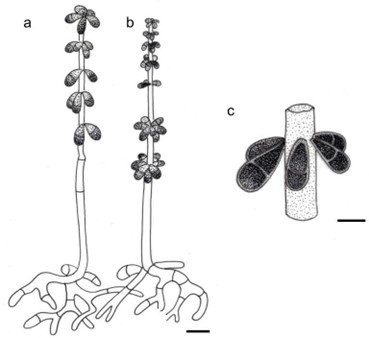
Figure 172 – Trichothecium roseum (redrawn from Halstead 1876 in Popular Science Monthly Vol 9). a-c Conidiophores with conidia. Scale bars: a, b = 20 µm, c = 10 µm.
Species