
Rigidoporus juniperinus Gaforov, L.W. Zhou & E. Langer, sp. nov.
Index Fungorum number: IF 830651; MycoBank number: MB 830651; Facesoffungi number: FoF 06108; Figs. 98, 99
Etymology: The epithet reflects the name of the host genus Juniperus.
Holotype: TASM 6139.
Basidiocarp annual or perennial, resupinate, without odor or taste, soft when fresh and becoming hard when dry, sometimes with moss cover and, up to 10 cm long, 4 cm wide, and 3 mm thick at the center; margin sterile or fertile, whitish, soft, up to 2 mm wide. Pore surface whitish when fresh, drying cream-colored to pale ochraceous; pores circular to angular, 4–5 per mm; dissepiments thin, sometimes thick where close to margin of basidiocarp. Subiculum cream, up to 3 mm thick. Tubes concolorous with pore surface, stratified, each tube layer up to 2 mm long. Hyphal system monomitic; all hyphae hyaline with simple septate, lacking clamp connections, negative in Melzer’s reagent, cyanophilous in Cotton Blue; unchanged in KOH. Contextual skeletal hyphae straight and flexuous, thick-walled with a large lumen, unbranched, usually regularly arranged, interwoven, 4–5 μm diam. Tramal hyphae thin- to distinctly thick-walled with a narrow to wide lumen, branched, frequently simple septate, strongly flexuous, interwoven, 1.8–3 μm diam. Hymenial cystidia present; clavate, or narrowly clavate, sometimes curved, with apical encrustation, simpleseptate at base, hyaline, thin-walled, smooth, partly projecting into the hymenium, 11–17×4–5 µm; some hyphae at the dissepiment edge bearing crystals and resembling hyphoid cystidia; cystidioles absent. Basidia clavate, without basal clamp connection, with a simple septum and four sterigmata, 15–20×4–5 µm; basidioles in shape similar to basidia, but smaller, 10–18×3–5 µm. Basidiospores broadly ellipsoid to globose or subglobose, hyaline, thin-walled, smooth, negative in Melzer’s reagent, acyanophilous in Cotton Blue, (3.9– )4.2–4.5(–4.9)×2.9–3(–3.5) µm, L=4.1 µm, W=3.02 µm, Q=1.29–1.50 (n=30/1).
Material examined: UZBEKISTAN, Jizzakh Province, Zaamin districts, Zaamin National Park, northern slope of Turkistan range of Pamir-Alay mountain system, Juniper forest, on rotten stump and stem of Juniperus polycarpos var. seravschanica (Kom.) Kitam. (Cupressaceae), 10 September 2017, 1700 m alt., Y. Gafforov, YG575 (TASM 6139, holotype); ibid. Y. Gafforov, YG1070 (TASM 6140).
GenBank numbers: ITS: MK433640, MK433641; LSU: MK433642, MK433643.
Notes: Rigidoporus juniperinus is characterized usually by annual resupinate basidiocarps covered in moss, white to cream-coloured pores, presence of hyphoid cystidia and lack of cystidioles and globose to broadly ellipsoid basidiospores. It grows on coniferous wood in juniper forests. From the phylogenetic perspective inferred from the concatenated ITS and LSU regions (Fig. 100), two specimens of R. juniperinus formed a distinct clade with full support in Rigidoporus. The closest phylogenetic species to R. juniperinus is R. cuneatus (Murrill) F. Wu, Jia J. Chen & Y. C. Dai. However, there are morphological differences between R. juniperinus and R. cuneatus. R. juniperinus has broadly ellipsoid to subglobose, basidiospores (3.9–)4.2–4.5(–4.9) ×2.9–3(–3.5) μm while R. cuneatus has mostly globose and bigger basidiospores (3–5 μm). Morphologically, R. juniperinus is very similar to Oxyporus corticola (Fr.) Ryvarden. However, O. corticola has larger and ovoid basidiospores ((4.5)5–6×3.5–4.5 μm, Ryvarden and Gilberston 1994). R. juniperinus also resembles O. populinus (Schumach.) Donk by sharing annual, resupinate basidiocarps covered with moss at the base, cream-coloured pore surface, approximately the same shape and size of basidiospores, and abundant encrusted cystidia (Ryvarden and Gilberston 1994). However, the latter species has small pores (6–8 per mm), capitate to cylindrical larger cystidia, interwoven hyphae in the subiculum, and grows on angiosperm wood, while R. juniperinus has bigger pores (4–5 per mm), most of the skeletal hyphae are regularly arranged in the subiculum, an absence of cystidioles and distinctly thick-walled hyphoid cystidia, clavate and bigger basidia and grow on coniferous wood. These fungal species have many crystals and encrustations on the hyphae which is a common ecological adaption for aphylloporoid species that minimizes water loss in arid and semiarid regions of Central Asia (Gafforov et al. 2017).
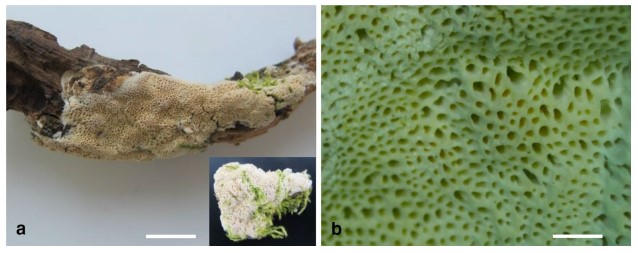
Fig. 98 Macroscopic structures of Rigidoporus juniperinus (TASM 6139, holotype). a Basidiocarps cover with moses. b Pores surface
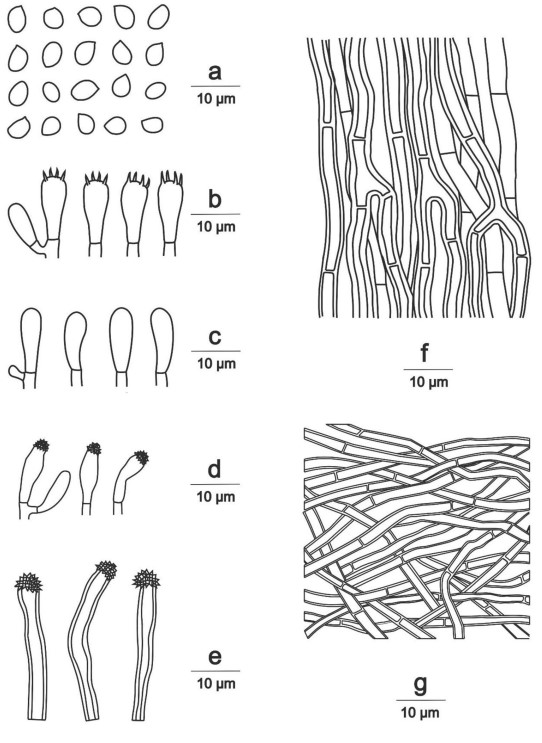
Fig. 99 Microscopic structures of Rigidoporus juniperinus (TASM 6139, holotype). a Basidiospores. b Basidia. c Basidioles. d Hymenial cystidia e Cystidioid hyphal ends. f Hyphae from trama. g Hyphae from subiculum