Paradictyoarthrinium diffractum Matsush., Matsush. Mycol. Mem. 9:18 (1996).
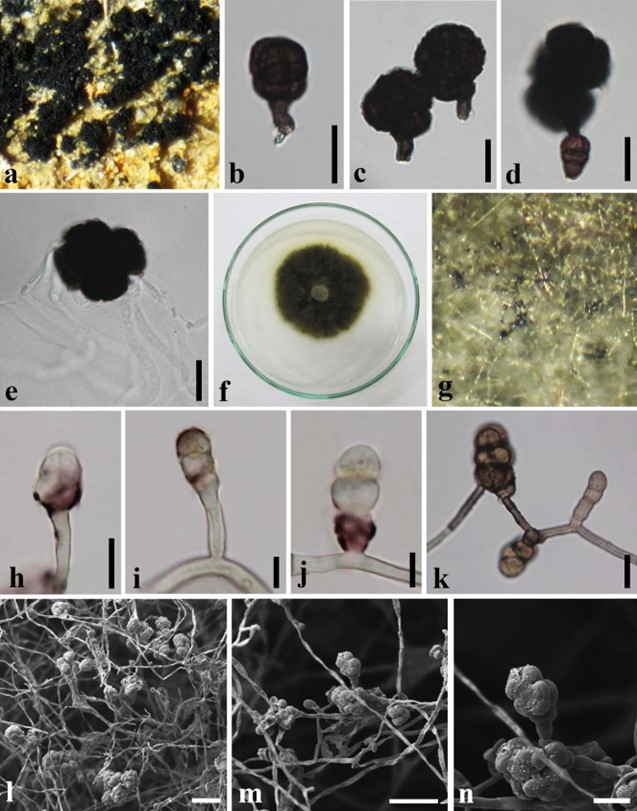
Index Fungorum number: IF 415849; MycoBank number: MB 415849; Facesoffungi number: FoF 01854. Fig. 1
Saprobic on decaying wood. Sexual morph Undetermined. Asexual morph Colonies on natural substrate, superficial, effuse, gregarious, scattered, black, shiny. Mycelium mostly superficial, partly immersed, composed of branched, septate, brown. Conidiophores 5–19 μm long, 4–5 μm wide, macronematous, erect to slightly curved, arising from hyphae. Conidiogenous cells blastic, integrated, terminal, determinate. Conidia 12–20×11–19 (x̅=15×16 μm, n=10), muriform, subglobose to irregular in shape, dark brown to black solitary, developing in branched chains, with 1–2 short chains, variable in shape and size.
Culture characteristics – Conidia germinating on PDA within 24 h and germ tubes produced around conidia. Colonies on PDA reaching 5 cm diam. after 4 weeks incubated at 25 °C, superficial, dense and woolly, raised effuse, dull surface, velvety, olivaceous grey to dark grey, radiating outwards, entire edge
Material examined – : THAILAND, Mukdahan Province, on decaying wood, 24 July 2019, S. Boonmee, WD10 (MFLU 21-0065, new record), living culture MFLUCC 21-0088.
GenBank numbers – ITS = MZ538520, LSU = MZ538554, SSU = MZ538573, RPB2 = MZ567112, TEF1-α = MZ567097.
Notes – We collected a fungal strain from woody substrates in northeastern Thailand and it identified as Paradictyoarthrinium diffractum with the support of morphology (Fig. 1) and phylogenetic evidence (Fig. 2). Our isolate MFLUCC 21-0088 clustered among P. diffractum strains (MFLUCC 13-0466, MFLUCC 12-0557, 117F5C-AC, UFMG PEZEQ5, NFCCI-4665, KUMCC 19-0111, HUEFS 212651, BCC 8704, GUFCC 15514) with 82% MLBS, 0.99 BYPP support. This is a new record of P. diffractum reported from northeastern Thailand. This may be a species complex.

Figure 1 – Paradictyoarthrinium diffractum (MFLU 21-0065, new record). a, b Colonies on woody substrate. c Conidial masses arising from conidiogenous cells. d–i Conidiogenous cells with attached conidia. j, k Conidia. l Germinated conidium. m, n Culture on PDA from surface and reverse. Scale bars: c=20 μm, d–i, l=10 μm, j, k=5 μm

Figure 2 – Maximum likelihood phylogenetic tree based on a combined LSU, ITS, RPB2, SSU and TEF1-α sequence data of Paradictyoarthrinium taxa (Paradictyoarthriniaceae) and related families. The tree is rooted with Melanomma pulvis-pyrius (CBS 124080). Bootstrap support values for maximum likelihood (MLBS, left) equal to or greater than 70% is given above the nodes. Bayesian posterior probabilities (BYPP, right) equal to or greater than 0.95 are given above the nodes. Newly generated sequence is in blue