Thyridaria broussonetiae (Sacc.) Traverso, Fl. ital. crypt., Pyrenomycetae (Florence) 1(2): 301 (1906)

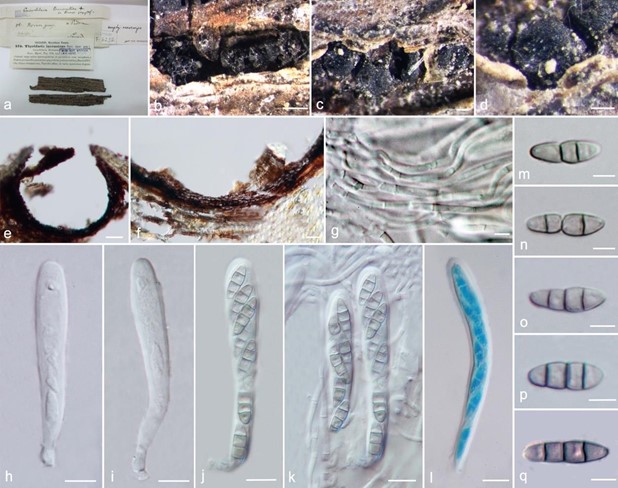
Index Fungorum number: IF569945; MycoBank number: MB569945; Facesoffungi number: FoF 08376; Fig. 1

Holotype – not indicated. W 2009-01175 (Lectotype designated by Jaklitsch and Voglmayr 2016).

Saprobic on the bark of Citrus maxima Merr. Sexual morph: Stromata 0.5–1.0 mm diam., flaky, solitary or aggregated, yellow or pale brown, lose or dense fluff on the surface, flat circular to convex disc or poolville. Ascomata 300–660 µm high, 420–550 µm diam. (x=480×500 µm, n=10), immersed, solitary, part aggregated, subglobose, dark brown to black, central ostiole, with minute papilla. Ostiole 20–100 µm filled with black keratinous substance. Peridium 20×50 µm wide, consists of 5–7-layers of hyaline to brown, cells of textura angularis from the inside to the outside. Hamathecium of 2–3 µm wide, cylindrical, filamentous, unbranched, hyaline pseudoparaphyses. Asci
100–150×10–20 µm (x=130×15 µm, n=23), 4–8-spored, cylindric to clavate, slightly curved, with bulbous short pedicels, apically rounded, endotunica thick, wall thin. Ascospores 20–30×7–11 µm (x=20×7 µm, n=30), uniseriate, ellipsoid to fusiform, ends blunt, straight or slightly curved, pale or light brown when young, blackish-brown at maturity, 3-septate, constricted at the septate, some have obvious guttulate, smooth-walled. Asexual morph: Undetermined.

Culture characteristics – Ascospore germinating on PDA within 24 h at room temperature, Colonies on PDA reaching 35 mm diam. after 1 month at 25 °C, circular, white grey at the edge, dull brown to olivaceous brown from the center to edge, mycelium dense and soft. Reverse with dark brown center, light grey edge.

Material examined – China, Guangdong Province, Shaoguan City, Renhua County, Dongtang Town, 25° 3′ 50″ N, 113° 39′ 17″ E, alt. 100 m, on the bark of Citrus maxima (Rutaceae), 25 August 2021, Y.H. Yang, (MHZU 22-0064); living culture, ZHKUCC 22-0116, ZHKUCC 22-0117.

Hosts and distribution – Southern Europe: Italy on Broussonetia papyrifera, Hungary on Amorpha fruticose (Epitype), Croatia on Hippocrepis emerus (Jaklitsch and Voglmayr 2016); China on Citrus maxima (this study); as Cucurbitaria broussonetiae on Albizzia sp., Calycanthus, Chimonanthus, Colutea sp., Fagus sylvatica, Juglans regia, Morus sp., Prunus padus, Rhus sp. and Robinia (Saccardo 1875).

GenBank numbers – ITS: OQ976012, OQ976013; LSU: OQ976019, OQ976020.

Notes – In the multi-gene analysis of ITS, LSU and tef1-α gene sequences of Thyridaria species indicates that our isolates (ZHKUCC 22-0116, ZHKUCC 22-0116) grouped with the Thyridaria aureobrunnea including ex-type strains (CBS 141481) with ML/BI=100%/1.00 bootstrap support (Fig. 2). Our collection is morphologically similar to the epitype collection of T. aureobrunnea. We identified our collection as T. aureobrunnea and this is the first record of T. aureobrunnea on honey pomelo (Citrus maxima).

Figure 1 – Thyridaria broussonetiae (MHZU 22-0064). a, b Ostiolar discs and stroma surface on the host substrate. c, d Vertical cross section of ascoma e Peridium. f Pseudoparaphyses. g, h Asci. i–k Ascospores. l Germinating ascospore. Scale bars: d=200 µm, e, f, i–l=20 µm, g, h=50 µm

Figure 2 –  The best scoring RAxML tree of combined dataset of ITS, LSU and tef1-α for sequence data of taxa in Thyridariaceae. The topology and clade stability of the combined gene analyses was compared to the single gene analyses and there is no significant difference between them. The tree is rooted with Occultibambusa bambusae (MFLUCC 11-0394 and MFLUCC 13-0855). The matrix had 564 distinct alignment patterns with 23.32% undetermined characters and gaps. Estimated base frequencies were as follows; A=0.238335, C=0.264925, G=0.281630, T=0.215110; substitution rates AC=1.514255, AG=3.124473, AT=2.468484, CG=1.311510, CT=8.752761, GT=1.0; gamma distribution shape parameter α=0.169591 with a final likelihood value of—9484.250024. Ex-type strains are in bold and newly generated sequences are in blue bold. Bootstrap support for ML equal to or greater than 70% and BI equal to or greater than 0.95 are given above the nodes