
Submersispora variabilis W. Dong, H. Zhang & K.D. Hyde, sp. nov.
MycoBank number: MB 557917; Index Fungorum number: IF 557917; Facesoffungi number: FoF08720; Fig. 67
Etymology: referring to variable shape of conidia
Holotype: MFLU 17-1719
Saprobic on decaying, submerged wood in freshwater. Sexual morph: Undetermined. Asexual morph: Colonies broadly punctiform, gregarious or scattered or solitary, raised, black. Mycelium mostly immersed in natural substratum, consisting of branched, septate, thin-walled, smooth, hyaline to pale brown hyphae. Conidiophores up to 230 µm long, 3 µm wide, semi-macronematous, mononematous, cylindrical, slender, unbranched, septate, slightly constricted at the septa, smooth, pale brown, thin-walled. Conidiogenous cells 5.2–6.4 × 5.5–6 µm (x̄ = 5.8 × 5.7 µm, n = 5), monoblastic, holoblastic, integrated, determinate, cuneiform, pale brown, smooth. Conidia 26.5–185.5 × 35–90 µm (x̄ = 96.5 × 65.7 µm, n = 30), acrogenous, solitary, dry, variable in shape, mostly subglobose, ellipsoidal, oblong, irregular, septate, muriform, slightly constricted at the septa, comprising large number of angular cells, hyaline to brown when young, dark black and invisible for septa when mature, smooth, thin-walled.
Culture characteristics: On PDA, colony circular, reaching 30 mm in 15 days at 25 °C, grey in the middle with dark brown margin from above, dark brown from below, surface rough, fluffy, with dense mycelium, dry, raised, edge entire.
Material examined: THAILAND, Chiang Mai Province, MRC, on submerged wood in a stream, 1 September 2017, X.D. Yu, 2A (MFLU 17-1719, holotype), ex-type living culture MFLUCC 17-2360.
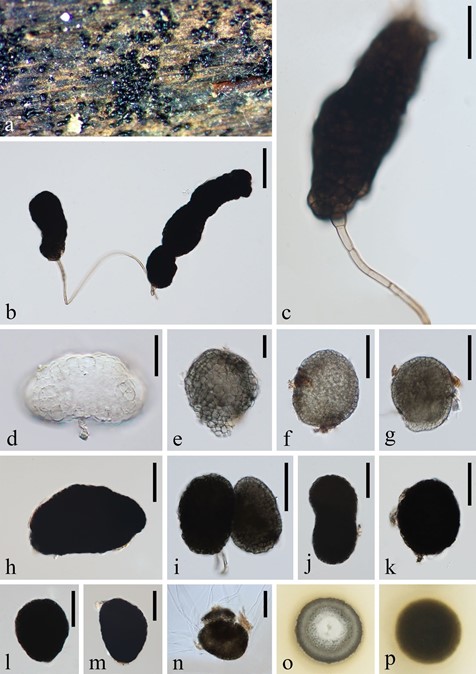
Fig. 67 Submersispora variabi- lis (MFLU 17-1719, holotype). a Colonies on submerged wood. b Conidiophores with conidia. c Conidium, conidiogenous cell and conidiophore. d–m Conidia. n Germinated conidium. o, p Colony on PDA (left-front, right-reverse). Scale bars: b, f–n = 50 μm, c–e = 20 μm